Yamsuan eyes unified medical records system to cut healthcare costs, improve patient services
Advertisers
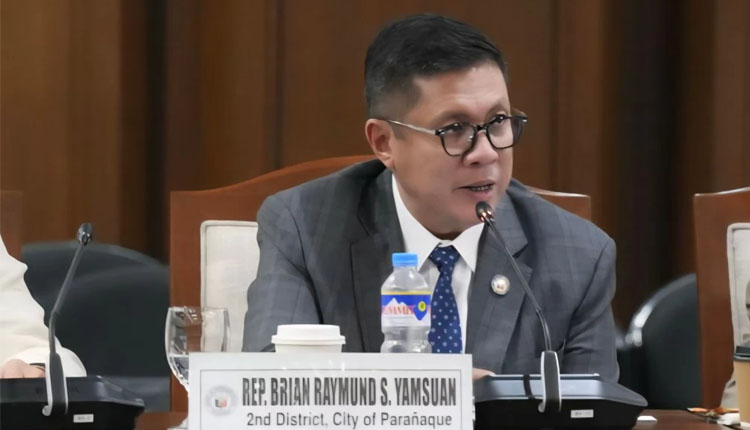
Parañaque 2nd District Representative Brian Yamsuan has urged Congress to pass a measure that aims to establish a unified and secure Electronic Medical Records (EMR) system to improve the delivery of patient services and help reduce health care costs for the government.
Yamsuan said his proposal will provide the Department of Health (DOH) the system it needs to enhance the operational efficiency of government-run hospitals and cut costs incurred from the disorganized handling of patient health information.
“When the House Committee on Appropriations conducted hearings on the proposed DOH budget for 2027, Health Secretary (Edwin) Mercado said that among the actions he would undertake to ensure the cost-effective spending of the Department’s funds was to improve the coordination between DOH hospitals and local hospitals. Our proposed unified Electronic Medical Records system is a key factor in realizing this goal,” Yamsuan said.
Yamsuan had asked during the hearing how the DOH would be able to implement its priority programs after the Department of Budget and Management (DBM) slashed its P837 billion budget proposal to P353.8 billion under the 2027 National Expenditure Program. The House of Representatives plans to realign items under the proposed 2027 national budget to increase the DOH’s allocation, taking into account the tight fiscal space for next year.
Mercado had explained that strengthening the inter-referral scheme between DOH hospitals and health care facilities run by the local government units (LGUs) would be among the steps that he will initiate to improve the efficiency of health care spending.
Under this inter-referral arrangement, the disjointed setup between DOH hospitals and LGU-managed healthcare providers would be integrated and closely coordinated. Through this mechanism, patients could be moved seamlessly from LGU-run facilities to DOH hospitals, and vice versa, when necessary.
This close coordination ensures the continuity of patient care without resorting to the duplication of diagnostic procedures and cuts overhead costs for, and avoids congestion in, higher-level hospitals.
Mercado said he will create a new cluster within the DOH to focus solely on hospital operations to finetune this inter-referral arrangement.
While expressing full support for Mercado’s initiative, Yamsuan said that a unified EMR system should be in place to ensure that the inter-referral scheme would run smoothly and avoid costly errors and medical mistakes, especially when patients have to bring with them paper-based results of diagnostic procedures.
“Minsan, yung nagawa ng laboratory tests sa LGU health care facility, uulitin pa din pagdating ng pasyente sa DOH hospital dahil walang koordinasyon, kaya’t nadodoble ang gastos para sa gobyerno. In other cases, patients who have to go to multiple doctors or from one medical facility to another have to repeatedly submit the same information in order to provide an accurate medical history, a process that is prone to error and loss of critical information,” Yamsuan said.
(Sometimes, the laboratory tests already done at the LGU health care facility is repeated at the DOH hospital because there’s no coordination, which is why expenses increase for the government.)
“These can all be avoided by establishing a unified EMR system, which, under our proposal, would be a secure and centralized digital platform that will record and store relevant patient information,” he added.
Under Yamsuan’s measure, the unified system will cover all public health facilities under the DOH, LGUs and government-owned and controlled health institutions. It would eventually be expanded to include private hospitals, clinics, diagnostic centers and other health service providers. This is similar to the system introduced in New Zealand.
The DOH, Department of Information and Communications Technology (DICT) and the Philippine Health Insurance Corp. (Philhealth) are tasked under the bill to establish the EMR system.
Access to the EMR is strictly limited to individual patients, their authorized representatives and accredited health facilities. Patients can grant or revoke consent to specific categories of sensitive data in their EMR except in cases of medical emergencies or legally recognized mandatory reporting.
Providing support to the EMR system are the National Privacy Commission for data protection and compliance; the Department of the Interior and Local Government (DILG) for the coordination with LGU health units; and the Philippine Statistics Authority (PSA) for identity authentication and portability.
Under the bill, hard copies of the EMR shall be maintained and stored as backup records.