
Yamsuan: Safeguards in Bicam-OKd 2026 budget bill to ensure gov’t programs to be felt by the people
Advertisers
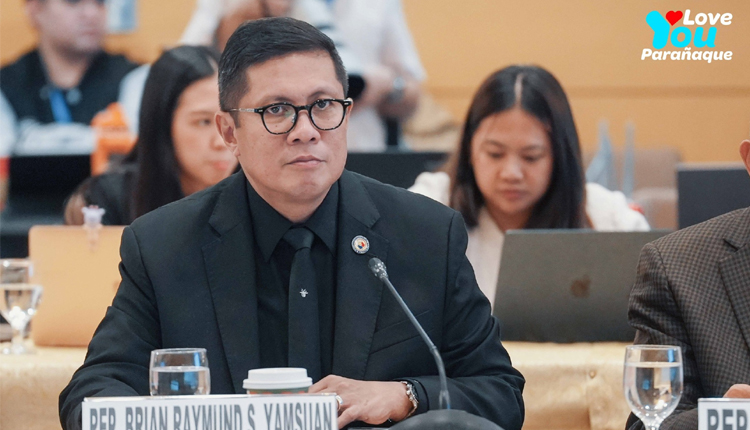
Parañaque 2nd District Representative Brian Raymund Yamsuan has assured the public that the various safeguards enclosed in the special provisions of the proposed P6.793 trillion General Appropriations Act (GAA) for 2026 would ensure that government programs and projects are insulated from politics and directly felt by the people.
Yamsuan said the technical staff of the Senate and the House of Representatives are now working double time to finetune the final version of the reconciled budget bill and its accompanying special provisions that were approved by the Bicameral Conference Committee (Bicam) during its deliberations held from Dec. 13 to 17, 2025.
The substantial increases approved by the Bicam in the funds for the education sector, which amounted to a whopping P1.38 trillion, and the Philippine Health Insurance Corp. (Philhealth), which totaled almost P130 billion, were among the notable developments pointed out by Yamsuan under the Bicam-approved proposed national budget.
“Ang mahalaga dito ay ma-execute nang maayos ang mga programa at proyekto na inaprubahan ng Bicam para ito ay maramdaman talaga ng ating mga kababayan,” said Yamsuan in several media interviews.
“(What is important is that these programs and projects approved by the Bicam are executed properly so that these would be truly felt by the people.)
“Katuwang kami ng Executive Department to ensure na lahat ng programs and projects ng gobyerno ay mararamdaman ng ating mga kababayan,” added Yamsuan, a member of the House of Representatives contingent to the conference committee.
(We are a key partner of the Executive Department to ensure that all programs and projects of the government are truly felt by the people.)
Under the Bicam-approved budget, the Department of Education (DepEd) and its attached agencies would get P961.3 billion, up by P86.7 billion from the amount proposed under Malacañang’s National Expenditure Program (NEP). State Universities and Colleges (SUCs) will receive P138 billion, the Commission on Higher Education (CHED), P47 billion, and the Technical Education and Skills Development Authority (TESDA), P26 billion. The remaining amount will go to other education-related programs.
Philhealth’s allocation increased from the original NEP level of P53.2 billion to P129.7 billion after the House of Representatives added P60 billion, and another P16.52 billion was included from the savings generated by the modifications in the budget for the Department of Public Works and Highways (DPWH).
The recomputation of the DPWH budget stemmed from the adjusted Construction Materials Price Data (CMPD) for 10,000 projects, which generated savings of P20.7 billion. After P16.5 billion was given to Philhealth, the remaining P4.25 billion went to the National Disaster Risk Reduction Management Fund (NDRRMF) to provide additional aid to calamity victims.
Moreover, the budget for the operation of Department of Health (DOH)-run hospitals increased from the NEP level of P26.4 billion to P29.9 billion; for DOH regional hospitals from P95.2 billion to P101.7 billion; and the Health Facilities Enhancement Program (HFEP), from P14.5 billion to P26.2 billion.
Yamsuan said the Bicam put in place adequate safeguards in the implementation of DPWH infrastructure projects, such as requiring that these have clear geographic coordinates and station numbers, and opening a transparency portal to allow the public to scrutinize these projects.
To enhance local autonomy, Yamsuan as a former Assistant Secretary of the Department of the Interior and Local Government (DILG) strongly backed the Bicam-approved increase of the Local Government Support Fund (LGSF) from P28 billion in the House-approved bill to P37 billion.
Yamsuan also dispelled concerns that the proposed GAA approved by the Bicam still contained ‘pork’ funds in the form of “soft projects” as he stressed that special provisions incorporated into the reconciled budget bill would ensure that patronage politics would have no place in the implementation of the 2026 national budget.
Among these “soft projects” is the allocation for the Medical Assistance to Indigents and Financially Incapacitated Patients (MAIFIP), The program involves the issuance of Guarantee Letters (GLs) by lawmakers and other government officials to public hospitals and accredited private hospitals, to help cover the medical bills of indigents and other financially challenged patients.
Yamsuan explained that the funds for this program are with the Department of Health (DOH) and not with government officials.
“We do not get hold of any funds from MAIFIP. We only issue GLs which are recommendatory. It is still up to the DOH whether to approve or not the GLs we have issued to help out our constituents reeling from their mounting medical bills, especially for those with catastrophic illnesses like cancer, kidney and heart diseases,” he said.
Yamsuan said MAIFIP remains a vital component of the national budget as a mechanism to swiftly extend medical aid to indigent patients, until such time that the government could effectively and fully implement the Universal Health Care Program.
“Once Philhealth shapes up and can effectively implement the provisions of the Universal Health Care program, we can give up MAIFIP. We just have to make sure that our countrymen get the medical care they need without having to worry about being buried in debt due to their mounting hospital expenses,” he added.